Netflix just
released this new series on ancient Rome called “Roman Empire: Reign of Blood” (2016)
and I just watched the first episode so I thought I would do a review.
Positive elements
Let me start off by
saying the things I liked about the first episode:
❶ The
series tries to stay true to the historical events, and to emphasise this, they
added documentary-like intermezzos where scholars give the viewer some historical
background.
❷ The
narrator is Sean Bean (Ned Stark from Game of Thrones). Everything this
man says just sounds epic.
Review of the authenticity of the props
I am always pleased when a new series
on ancient Rome becomes available, but this time I was somewhat dissapointed.
The first episode of
“Roman Empire: Reign of Blood” focusses on the Emperor Marcus Aurelius and his
son Commodus, in other words the same people you can see in Gladiator (2000). However, the latter came out 16 years ago and since it has become so much easier to access ancient sources,
see Roman reliefs, frescos, mosaics etc. online, I was hoping for
an improvement when it comes to the authenticity of the props. The storyline seems to be more accurate, but
the props
are not better, or maybe even worse (for the first episode at least). This really is a pity because there
have been movies and series since that were rather accurate when it comes to props like the movie
“Agora” (2009) or the HBO series “Rome” (2005).
Allow me to take you
through a few point that I believe are missed opportunities to take the series
to a higher level and give it a higher educational value.
Facial hair
While the early
emperors obviously preferred a clean-shaven look, all the emperors from
Hadrianus up until Caracalla were typically depicted with a beard [i]. As far as I am aware, all busts of both Marcus Aurelius and Commodus as emperors show them as
having beards, although busts made when they were still boys obviously have no
beards. One could argue that showing Commodus without a beard at the beginning
of the series makes sense because he is still young, but the previews show him
without a beard, even later on.
Marcus Aurelius' portayal without his characteristic philosopher's beard is even more astonishing. Especially since this
series was made in 2016, at a time when long beards have been fashionable again for a while
so the reason for this omission cannot be because the makers wanted to avoid alienating today’s audience. Did they simply forget to do a Google image search for
their names? Even the movie Gladiator showed Marcus Aurelius with a beard.
 |
| Emperor Marcus Aurelius photographs by Rosco, Giovanni Dall'Orto, Gryffindor, Pierre-Selim, emperor Commodus photographs by sailko, Gryffindor, Segafredo18, and Marie-Lan Nguyen. |
Hairstyles
Several women in the
first episode, including the Empress Faustina Minor are shown with loose or
semi-loose hair, but throughout the Roman era, loose hair was
associated with death and mourning [ii].
It is obvious from busts of Faustina Minor that she, like most Roman women at the
time, wanted to look as refined as possible and her neat hairstyle was one way
to achieve that.
The kind of hairdo one would see on a girl who comes to a Halloween party dressed as a “Greek Goddess” is something I was not surprised to see on the "Spartacus" series (2010-2013), but I was
surprised to see it on "Roman Empire: Reign of Blood". "Agora" and HBO’s "Rome" were able to recreate Roman hairstyles with much more success. There is plenty of information
available on ancient Roman women’s hairstyles (even on YouTube [iii]) so one onders why they did not research this properly.
 |
| Faustina Minor photographs by Sailko, Anagoria, ChrisO, CNG. |
Helmets
At one point, the
narrator Sean Bean says that the soldiers were “equipped with the latest weaponry”, however, at that exact
moment the images showed marching soldiers wearing Montefortino type helmets, which were
typically used centuries before that during the Republican era (509 BCE–27 BCE), but possibly up
until the early 1st century CE [iv]. This series however is supposed to
depict the the late 2nd century CE.
Other helmets shown in the
series are not unlike the
helmets on the Column and the Arch of Marcus Aurelius. Others are of the typical Imperial Gallic type, so this seems acceptable. However, if they had helmets who look more or less authentic from a distance to their disposal, one wonders why they used Montefortino helmets at all.
 |
| Relief photograph by Jastrow, quinet (Thomas Quine). |
 |
| Relief photograph by Borosaurus Lentus, helmet photograph by TIMOTHEVS (Nijmegen, Netherlands) |
Commodus as a "Gladiator"
The scene where Commodus fights as a gladiator is far from convincing. Not only do the moves look overly choreographed, his equipment hardly resembles that of a
gladiator. The gladiators are not wearing helmets, and Commodus' scutum (shield)
has straps instead of a centre grip. For more details on this subject, I refer you
to my video or blogpost on the seven most popular types of gladiators of Imperial Rome.
Wine cups
There are several
types of wine cups you can see on frescos, reliefs and mosaics and they
correspond to what has been excavated. Replicas of all of these types are
readily available online or at many museum shops, so I do not know why they
did not simply use some of those instead the new age chalices they used. When it
comes to wine cups, they did a better job in the “I Claudius”, eventhough that series was made during the 1970’s.
 |
| Silver cantharus photograph by Sailko, Silver scyphus photograph by Marie-Lan Nguyen, other photographs by TIMOTHEVS. |
Candles
Although candles were
used during the Roman period, oil lamp were much much more common [v]. In the
series, I believe I spotted one Byzantine-style oil lamp for a brief moment, but
there was a disproportionate number of candles.
 |
| Photographs by TIMOTHEVS. |
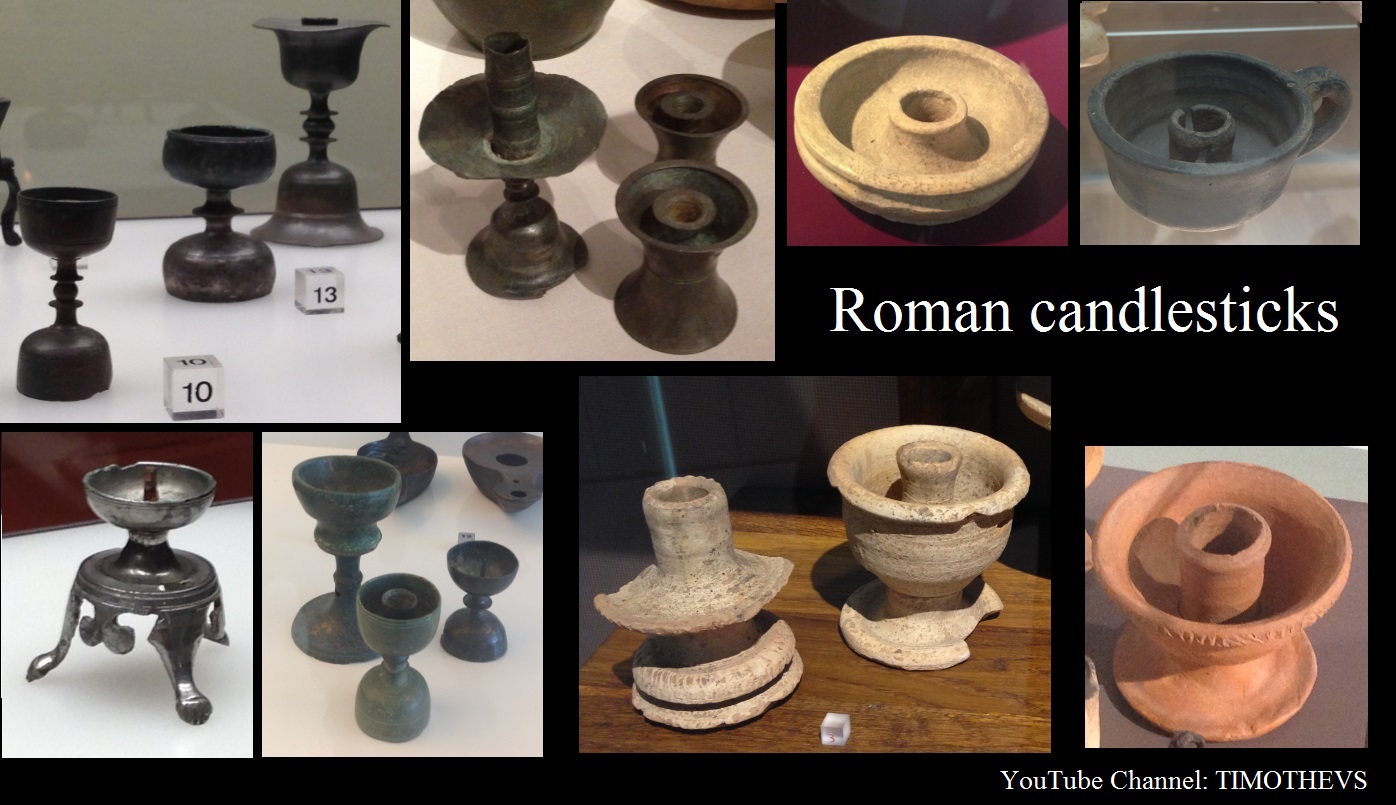
If they preferred candles, they should have opted for some of the typical kinds of
Roman candle stick holders instead of the modern chandeliers which look
nothing like the real thing. One is inclined to imagine the makers sending a few people to a random home
decor shop saying “Just bring whatever looks a bit old-fashioned guys.”
 |
| Photographs by TIMOTHEVS. |
Cuffs
For some reason,
modern filmmakers insist on depicting Roman men with a pair of cuffs, and I
really wonder where this comes from. I have been paying attention to this for
years, but I have never seen a contemporary depiction of a Roman soldier or
emperor wearing any. Perhaps, there actually is depiction of a Roman man
wearing this kind of bracelet out there, because even some characters on HBO’s
"Rome" wore them (If you happen to know where film makers got this idea, please
let me know!). Cuffs cannot have been that common though, at least not in this era, as none of the individuals portrayed on the Arch and the Column of Marcus Aurelius seems to be wearing any.
If it had been just
one or even two of the aforementioned inaccuracies, I would have gladly forgiven the makers of "Romane Empire: Reign of Blood", but the
fact that they made this many mistakes gives a very sloppy impression. It makes one wonder if they even had a historical advisor at all.
References:
[i] For an overview with pictures: https://en.wikipedia.org/wiki/List_of_Roman_emperors
(accessed: November 18, 2016).
[ii] Tibullus 1.1, 59-68. & Thorsten Fögen (editor) (2009) Tears in the Graeco-Roman World. Literart Criticism: p140.
[iii] YouTube user Janet Stephens has several videos on how to recreate Roman hairstyles https://www.youtube.com/user/jntvstp (accessed: November 18, 2016).
[iv] Travis, John and Hilary Travis. Roman Helmets (2014). Amberley Publishing Limited: "MONTEFORTINO - TYPES A TO F" in chapter IV.
[v] Morris, Ting (2006) Arts and Crafts of Ancient Rome. Black Rabbit Books: p21.
[v] Morris, Ting (2006) Arts and Crafts of Ancient Rome. Black Rabbit Books: p21.


